The property graph model#
AgensGraph stores data in two shapes at once: as relational tables, and as a property graph. This page defines the graph half — the five things a graph is made of, and the rules each one obeys in AgensGraph specifically.
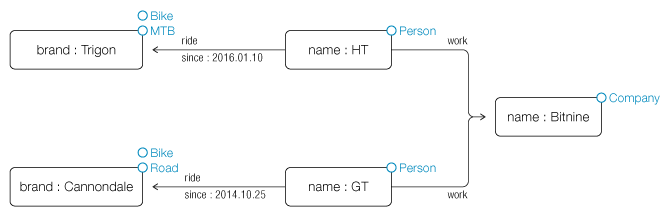
Vertices#
A vertex is an entity: a person, a film, an account, a sensor. It has an identity, a label, and any number of properties.
A vertex belongs to exactly one label. That is the rule most likely to differ from a graph database you have used before — there is no set of labels per vertex. Where you would reach for several labels on one vertex, use label inheritance instead, which lets one pattern match a family of labels.
Edges#
An edge connects two vertices. It has an identity, a label, any number of properties, and a direction: it always has a start vertex and an end vertex.
Three rules hold in AgensGraph:
An edge always has a label. There is no unlabelled edge.
An edge always has both endpoints. A dangling edge cannot exist, so deleting a vertex that still has edges is refused:
ERROR:  Vertex with connected edges cannot be removed
HINT:  Use DETACH DELETE or remove connected edges before deleting the vertex.
Direction is recorded, and matching it is optional. You store an edge one way round and decide per query whether direction matters:
-[:acted_in]->follows it,-[:acted_in]-ignores it. There is no reason to store the mirror image of an edge.
Properties#
Properties are the data on a vertex or an edge. A property has a string name and a value.
Properties are stored as a single jsonb document per element, so the value can be any JSON
type: a string, a number, a boolean, an array, or a nested object. Two consequences:
A label imposes no column list. Two vertices with the same label may carry entirely different property names. Nothing has to be declared in advance.
nullis not a property value. Assigningnullremoves the property:MATCH (n:person {name: 'Tmp'}) SET n.born = NULL RETURN n; person[4.40]{"name": "Tmp"}
So a property set to null and a property that was never there are the same thing. Turning on
allow_null_propertieschanges that, and the null is stored:person[4.40]{"born": null, "name": "Tmp"}
Because a read has to go into a JSON document, a property that every query filters on can be worth promoting to a typed column. That is a performance choice, not a modelling one — the property stays a property.
Note
n.id is not a vertex’s identity. It reads a property named id, which usually does not
exist. The identity is id(n).
Labels#
A label groups elements of the same kind. movie, person, acted_in are labels.
A label is what you attach an index to, what you grant permissions on, and what a pattern
names to narrow a search. Vertex labels and edge labels are distinct kinds, created with
CREATE VLABEL and CREATE ELABEL, and a name may be used once per graph.
Every graph is created with two labels you do not declare: ag_vertex and ag_edge. Every
label you create inherits from one of them. That inheritance is what makes an unlabelled
pattern like MATCH (n) mean “any vertex”. A vertex created with no label at all lands in
ag_vertex:
CREATE ({tmp: 1});
MATCH (n:ag_vertex ONLY) RETURN label(n) AS label, id(n) AS id, n.tmp;
    label    | id  | tmp
-------------+-----+------
 "ag_vertex" | 1.3 | 1
You cannot name the default label yourself:
CREATE (:ag_vertex {tmp: 1});
ERROR: specifying default label is not allowed
Label names are folded to lower case unless you double-quote them, the same way PostgreSQL folds unquoted identifiers. A backtick is not a quoting character here — see Syntax.
Paths#
A path is a sequence of vertices joined by edges. It is a value in its own right: you can bind it to a variable, return it, and ask for its length or its members.
MATCH p = (a:person {name: 'Keanu Reeves'})-[:acted_in]->(m:movie)
RETURN length(p) AS hops, a.name AS actor, m.title AS film
ORDER BY film LIMIT 2;
 hops |     actor      |         film
------+----------------+-----------------------
 1    | "Keanu Reeves" | "The Matrix"
 1    | "Keanu Reeves" | "The Matrix Reloaded"
A path’s length is its number of edges, so a single vertex is a path of length 0 and an edge to itself is a path of length 1. Paths are how you express “any number of hops”: see Paths for variable-length patterns, shortest paths and weighted search.
Graphs#
A graph is the container for labels, and a database may hold several. A graph is also a PostgreSQL schema, so a graph name and a schema name cannot collide — see How a graph is stored.
A session works in one graph at a time, named by graph_path:
SET graph_path = moviekb;
Without it, nothing resolves:
ERROR:  graph_path is NULL
HINT:  Use SET graph_path
graph_path takes exactly one graph name, and a pattern cannot qualify a label with a graph
name — MATCH (n:other.work) is a syntax error. To read two graphs in one statement, use
SQL, which sees them as two schemas:
CREATE GRAPH other;
SET graph_path = other;
CREATE VLABEL work;
CREATE (:work {title: 'A'}), (:work {title: 'B'});
SET graph_path = moviekb;
SELECT (SELECT count(*) FROM moviekb.movie) AS movies,
       (SELECT count(*) FROM other.work)    AS works;
 movies | works
--------+-------
     18 |     2
DROP GRAPH other CASCADE;
Because graph_path is a per-session setting, set it for the database if every session wants
the same graph:
ALTER DATABASE mydb SET graph_path = moviekb;